 King
James Bible Investments was established as a place for family,
friends, acquaintances and other Christians to be informed
about world market conditions and as a place to preserve
their capital by investing in the only form of real money,
gold and silver. King
James Bible Investments was established as a place for family,
friends, acquaintances and other Christians to be informed
about world market conditions and as a place to preserve
their capital by investing in the only form of real money,
gold and silver.
Biblical records show that gold and silver are the first
and oldest form of money, the only money that has not failed,
and a source of omega replica notable value for over 5000 years! Can you
name one fiat currency that has lasted through even a few
centuries let alone a few millennia like gold and silver?
We think not!
Biblical
reasons why real money and wealth is gold and silver
-
The
Hebrew word for money is “keceph”, which is translated
to mean “silver.”
-
The
King James Bible mentions gold 417 times, silver 320
times, and money, which is mentioned 140 times, refers
to physical silver and gold. Not once does it mention
a paper currency.
-
Gold
and silver are mentioned all through the bible as real
wealth, even through the end of Revelation.
-
From
Genesis to Revelation, gold and silver are the only
God-ordained monetary assets that will maintain their
purchasing power until the day of the Lord’s wrath.
Biblical Gold
Don Stott
Gold is the first, and most frequently mentioned metal
in the Bible, as at Genesis 2:11. From the beginning, it
has been a noble metal, highly valued for its weight, rarity,
durable non-tarnishing luster, shimmering beauty, ductility,
and malleability. A number of Old Testament Hebrew terms
refer to gold, such as zahav, charuts, kethem, paz, seghor,
and ophir. In the New Testament, the Greek words khrysos
and khrysion are used as reference to ornaments, coins,
and gold in general.
Gold's rarity, throughout history, and even in Biblical
times, gave it a monetary value, which made it useful in
commercial transactions, as well as a measure of wealth
and prominence. The color and luster of gold, and its resistance
to oxidation or tarnishing, makes it valuable for jewelry
and ornamentation of all kinds. In early Biblical times,
it was found in its native purity in gravel deposits and
riverbeds. It was easily separated and recovered because
of its great weight. In the book of Job (28:1,2,6) mining
and refining operations are mentioned.
In the construction of the Tabernacle, built by Moses,
Exodus 25, 30, 37, and 39 describes using gold being beaten
into plates for overlay, sheets, and even thread used in
garments used by the high priest. In The Most Holy, the
Ark of the Covenant, was gold.
Solomon's Temple, extensively used gold in its d飯r.
As is done with several modern coins, even ancient Israel
evidently mixed an alloy with gold to harden it. (I kings10:16).
David set aside 100,000 talents of gold for Solomon's Temple.
A talent is about 75 pounds! The Temple's lamp-stands, utensils,
forks, bowls, pitchers, basins, cups, etc, were all made
of gold and silver, with a very few being made of copper.
The cherubs in the Most Holy, the alter of incense, and
even the entire inside of the house was overlaid with gold.
By today's prices, the gold in Solomon's Temple would probably
be valued at $50 billion.
Solomon received large amounts of gold from the King
of Tyre (120 talents), the Queen of Sheba (120 talents),
and from taxes and revenues from his own merchant fleet.
First Kings says that the weight of gold that Solomon received
in one year, was 636 talents of gold. The incredible amount
of gold that was transacted and used in David and Solomon's
day is unbelievable…but true.
When Israel captured cities, God commanded that they
not use the captured gold and silver for themselves. Evidently
the captured gold was re-refined to purify it. The exception
was Jericho. Its gold and silver were turned over to the
priests and used for sanctuary use, according to Jos. 6:17-19,
24.
Gold was so valuable and cherished, that in the Bible,
gold is likened to wisdom, faith and knowledge. Psalms says
that God's laws and commandments are more desirable than
gold. (Psalms 19: 7-10, 119:72, 127) Psalms also says that
while gold has great value, it is unable to give life. (Psalms
49: 6-8) Job says that no amount of gold can buy the wisdom
that comes from God. (Job 28: 12, 15-17,28) The Apostle
peter said ones' faith is of greater value than gold, which
can withstand fire, but be worn away by other means. (I
Peter 1:6,7) No amount of gold can deliver one in the day
of God's anger. (Zep 1:18) The point is that gold is the
most valuable thing one can possess, according to the Bible,
other than knowledge, faith, life, and righteousness.
Even in Biblical times then, TANGIBLE WEALTH, as opposed
to spiritual wealth, has always resided in gold, and silver.
Throughout recorded history, gold and silver have been actual
wealth, as opposed to currencies made of various things,
such as mulberry leaves, bark, cigarettes in WW II, sea
shells, and other trivia, but mostly PAPER. History, in
all faiths and in all books of wisdom, and various holy
books, have all used gold and silver as the ultimate form
of tangible wealth. In all races, and throughout all of
recorded history, gold and silver have been wealth, stability,
and irrefutable riches.
Today, as well as in past history, governments, kings,
rulers, and charlatans of all types, sizes, and sorts, have
used paper "instruments," as the sophisticates call them,
to hoodwink, steal, and defraud innocents. Be they paper
dollars, promises from hundreds of treasuries throughout
history and the world, or worthless bonds and stocks. All
such "instruments," are as good as the issuers of such,
and no more. A piece of paper, with scribbling or a beautiful
imprimatur, is only as valuable as its issuer. An IOU on
a piece of scrap paper, given you by a trustworthy individual,
is far more valuable than a million pieces of currency from
a bankrupt kingdom or nation.
Promises from a used car salesman or government bureaucrat,
can be honest or dishonest; valuable or worthless. The same
is true with papers of all sorts. A home is a tangible thing,
which can be lived in, raise kids in, sleep in, love in,
and die in, but a piece of paper can be destroyed with the
flick of a match. Tangible vs. fluff, in other words. Leadville
Johnny Brown, on a cold morning on Fryer Hill, in Leadville,
Colorado, burned a hundred thousand paper dollars, when
he started fire in his stove. Molly had hidden it there
so he wouldn't waste it. Gold and silver won't burn, and
if Molly Brown had hidden an equal amount of gold and silver,
Johnny couldn't have started that fire.
It continually amazes me, that by far the majority of
all populations of all nations, throughout history, have
believed the empty promises of their elected officials and
leaders. The common man, has always been fooled by those
richer, smarter, or better dressed than themselves. They
have gone along with the shallow plans and edicts, and used
their rulers monies to save. They have sent their kids to
their ruler's public schools, while they sent their own
to private ones. The majority, has usually been wrong in
all matters of state, it seems. Throughout history, this
has been so, be it in Biblical or modern times, the majority
has usually been proven wrong in their choices of rulers
or savings devices. When everyone does something, I usually
do just the opposite. I look at all the new cars whizzing
by my door, and am appalled at the wealth poured into them.
They lose value with every mile. My three old Mercedes ('73,
'74, and '85) give me great joy, incredible reliability
and economy, and go up in value with each month. My two
'41 Plymouths, equally. New cars, T bills, bonds of any
kind, and paper dollars, are absolutely the worst thing
one can do with surplus assets.
If you are religious or an atheist, one can determine
from any holy book or history, but especially the Bible,
that gold and silver are true tangible, physical wealth,
which will not burn, and have never lost their desirability,
or ability to purchase things. Gold and silver have always
been a measuring rod to determine value, and compare things
with, or scads of graphs and charts wouldn't be comparing
how many stocks one can buy with gold, or how many dollars
it takes to buy gold and silver. When long lost ships are
discovered beneath the oceans or seas, their recovery isn't
for their rudders or deck planking, which long ago have
disappeared. It is for the gold, which after a thousand
years beneath the briny deep, is still brilliant, beautiful,
and untarnished. History is not wrong.
I am always amused by the expression, "When everything
else fails, try reading the directions." Us guys hate reading
directions or asking for advice or directions when we are
lost. We think we are so damned smart. My clients and other
dealers' clients may be, but most guys and gals are as dumb
as wedges when it comes to investing and protecting themselves
is concerned. They all consort with their advisers who have
fancy offices and nameplates on their doors, with diplomas
neatly framed on the walls. When one is a "licensed financial
advisor," one might think that they might contact me occasionally,
rather than the continual in and out of stocks and bonds.
Not so. One might think that the majority of people everywhere,
might notice that "Gold Medal Flour," or the Lone Ranger's
horse and bullets, weren't named for dollars or euros. When
an Olympic medal winner stands proudly to receive his or
her award, they aren't given hundred dollar bills. They
are given the gold medal. Yet the public continues to ignore
what continually stares them in the face, and even in the
Bible's pages. Gold and silver are true wealth, with which
to protect yourself.
Why would someone want to buy real gold or silver or
other precious metals?
Why would someone want to buy real gold
or silver or other precious metals? There are two primary
reasons. The first is that coins or bars of these metals
have a durable, tangible and intrinsic value which derives
from their future utility in industry as well as their perceived
value as a financial instrument. Owners of precious metal
coins or ingots may use them as a form of savings, but they
sacrifice an interest on the savings, since such coins and
ingots bear no interest. An important counterpoint to the
loss of interest is that the asset value of each coin does
not correspond to an obligation of another party which may
be defaulted. The second reason to own precious metal coins
is to have an asset which is private or anonymous. One man
may choose to spend $100 on a dinner out, the other may
choose to buy $100 worth of gold. The one man has spent
his money, the other has saved it, privately. Although we
live in a computerized world with ever less financial privacy,
the owner of a precious metal is exercising a long tradition
of financial privacy.
An observation which justifies the ownership
of precious metals as a form of savings is that over time,
all printed monies of all nations tend to experience inflation.
Prices rise slowly, and the purchasing power of the money
falls slowly. Governments and their citizens tend to enjoy
inflation at low levels since it allows them to pay long
term debts back with inflated currency. A positive side
of mild inflation is that it tends to encourage savers to
place their money into interest bearing investments and
assets such as homes and stocks, in the hopes that the value
of their investments will grow faster than inflation. A
corollary to that is that everyone knows that only a fool
would stuff their money into a mattress for 20 years. But
precious metals, over the long term, tend to generally hold
their value just about even with inflation. There are occasionally
periods where the value of precious metals does not rise
with inflation, but those are usually followed by periods
where the price of the precious metals rises, sometimes
suddenly, and usually finds a new equilibrium price near
the level dictated by inflation.
For persons living in smaller countries
where governments have a history of destroying the value
of the currency, precious metals, primarily gold, represent
an asset which can easily be sold but which will not suddenly
lose value in a currency collapse. Even in modern times,
families in many nations in economic trouble have been able
to preserve their savings, through holding that savings
in gold, rather than their local currency. Those families
did not do this by suddenly converting their savings into
gold during a financial collapse, they did this during the
good times preceding the collapse, by slowly buying gold
each time they had spare savings.
Small countries who get into trouble with
their national debt, and print up a lot of new money trying
to fix things, and then see a dramatic collapse in the value
of their currency, are usually able to let a bunch of folks
go bankrupt, borrow a few billon dollars from the International
Monetary Fund, print a new currency and start over. They
are usually much more concerned about arranging bailout
loans than they are about the option to confiscate gold
or regulate or tax sales of gold.
America is in a very different situation.
We are already borrowing about $500 billion dollars per
year from foreigners. This is about 5% of our entire economic
activity (GDP). If America would get in trouble with the
national debt, print up a lot of new money trying to fix
things, and then see a consistent drop in the value of the
currency, yes, many of us could go bankrupt, but who would
bail us out??? If the dollar upon which we all have relied
is losing value, the central banks of the world might prefer
that Americans begin to save in other currencies such as
Yen and Euros, but just as likely is that Americans begin
to consider saving in gold. If this happens, the US Government
and Federal Reserve Bank will certainly see that a rush
away from dollars and into gold, by American citizens, is
a vote of no confidence for the dollar. The temptation will
be to restrict and regulate gold markets for Americans,
trying to force them into holding dollars. But the real
solution is for the Government to manage its spending and
the FED to manage back real trust in the dollar.
The situation in silver is even more dramatic.
Near the end of World War II, since America had been a large
silver producer, and had also accepted silver as payment
for war supplies, the United States Treasury (including
circulating coin) and the US Strategic Silver Reserve held
close to 10 billion ounces of silver. Since then, silver
has become an essential component in thousands of modern
products, and even though the amount of silver mined each
year has grown, the demand for silver has grown so much
faster, that most of those 10 billion ounces of silver reserve
have been used up. As a matter of fact, the ongoing availability
of silver from reserves has tended to keep the prices for
silver low, and so the global mining industry has not made
large new investments related to silver. In essence, the
world has been experiencing a shortage of silver for several
decades, and this has been hidden by the consumption of
reserves. Now, those reserves are gone. Silver known to
exist in vaults is only about 150-500 million ounces…2%
to 5% of the reserves we once had. Enough to cover a couple
short years of typical silver deficit, but that is not enough
time for the global mining industry to build mines to produce
an extra 200 million ounces per year of silver. A shortage
of silver is now eminent. Certain silver investors have
recognized the emergency situation in silver several years
ago.
The situation with silver is that an acute
shortage of silver (leading to certain industrial companies
closing down production lines if they can’t find silver)
may now occur almost simultaneously with inflationary erosion
in the value of various global currencies, particularly
the dollar, and a trend away from financial investments
such as stocks and bonds into commodities such as energy,
food, lumber, metals, etc. In any financial environment,
the rise in price caused by an acute and structural shortage
in silver will attract new interest in silver investment,
but this could even be more dramatic in a poor economic
environment where inflation is once again high. Many of
the world’s poorest nations are still prolific savers. If
even 1% of the savings generated in one year were to attempt
to invest in silver, the price of silver would easily move
to over $100/ounce. Historically, most serious investment
advisors would advise owning about 10% of an investment
portfolio in precious metals. If Americans now tried
to convert even 1% of their portfolios into silver, massive
increases in silver prices could occur.
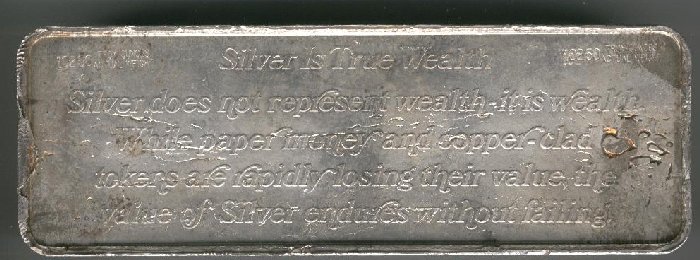
Did you know
that in 1980, 7 of these 100 oz. bars could buy a comfortable
house? Silver at it's sustained peak was valued at about
$45 / oz. It's now around $6 / oz. Will silver go up in
value or will real estate prices decline? Perhaps both will
occur. Regardless, wouldn't you like to own some physical
silver and buy a house with it in a few years?
“Great
opportunities are not seen with your eyes. They are seen
with your mind. Most people never get wealthy simply because
they are not trained financially to recognize opportunities
right in front of them.”
- Robert T. Kiyosaki
- Rich Dad/Poor Dad.
MORE VALUABLE THAN GOLD?
By James R. Cook
When I started Investment Rarities thirty-two
years ago, silver analyst Jerome Smith was already a legend.
In those years he made a series of price predictions for
gold, silver and platinum that were phenomenally accurate.
In 1967 he recommended his readers buy silver at $1.29 an
ounce. In 1971 he recommended gold at $42.00 an ounce. In
1977 he recommended platinum at $147 an ounce immediately
before it shot up to $1,000. In his 1982 book Jerome predicted
that within our lifetimes silver could very well be worth
more than gold. I recently revisited that prediction to
determine the exact basis for which Smith had made this
amazing claim.
In the 1970s Smith and silver were synonymous.
Here’s how he described his uncanny track record. "In 1972,
when I wrote the results of a five-year study of silver
in a book that has since been regarded as ‘the bible’ on
silver, I said that in the coming decade, ‘silver would
double in price and then double again.’ Only a few of the
many who read that in the early 1970s believed me. And I
was wrong. Instead of doubling twice, it doubled three times
over on an annual average price basis."
In 1980 silver climbed to $50 and fell
back to under $8 the ensuing year. Then in 1982, Smith claimed,
"I expect the price of silver to be in the $100-plus per
ounce range by 1985." Smith based this bullish conclusion
on five primary causes.
- Industrial demand for silver was exploding.
- Mining production of silver was less than consumption.
- Silver production couldn’t be greatly ramped up
because 75% of new silver came as a byproduct to base
metal mining.
- Since silver was used in such small amounts in its
many applications, a price rise in silver would not
reduce the demand.
- The government had sold off most of its two billion
ounce hoard in a way that kept the price down. Now that
it was gone, free market forces would re-establish the
true price at much higher levels.
Smith went on to predict, "Fundamentally,
the outlook for silver is more bullish from 1982 on than
for any other commodity I know of – including the much-ballyhooed
strategic metals. Silver in 1982 is a cheap precious metal
on the way to becoming a scarce and expensive strategic
precious metal within this decade."
How could this premier silver analyst,
who had so accurately predicted the price rise for silver,
gold and platinum in prior years, miss the mark so widely
in the 1980s? For one thing, his 1972 book on silver was
read by the Hunt Brothers, who claimed it was instrumental
in their driving up the price of silver. In that sense,
his accurate prediction was a self-fulfilling prophecy more
than it was a shortage of silver. To some extent, Smith
underestimated the above-ground supply of silver going forward.
However, the greatest reason that Smith’s
predictions failed to come to pass has been outlined many
times by today’s premier silver analyst, Theodore Butler.
In the 1980s, the world’s supply of above-ground silver
was rapidly being depleted and the price should have been
moving higher rather than stagnating. Ted Butler became
the first analyst to pinpoint why. The world’s remaining
stockpiles of silver, mostly in foreign government hands,
were being leased out and then sold off at low prices. This
selling kept the price depressed. In this process, the silver
market was oversupplied. No thought was given to getting
the best price. Free market mechanisms that would have lifted
the price of silver were overwhelmed by a glut of silver
sold off by the banks and brokers, who leased the silver
from foreign governments and others. They sold it off differently
than would the true owners. They were more interested in
the silver lease rate than the price. Some might even have
wanted the price to stay low.
Ted Butler also pointed out a second
crucial fact. A few large trading houses and banks had been
able to get a stranglehold on the silver futures market.
Their finances dwarfed the size of the silver market, and
it was highly profitable to take the short side of futures
transactions and cash in when the price dropped. (They could
sometimes engineer the drop by lowering their bid prices.)
This could also be highly profitable for them in writing
options.
These two artificial market tactics acted
somewhat the same as price controls. Ted Butler has pointed
out that, by holding the price down, these manipulations
have made silver all the more attractive to silver buyers
because of the resulting low price. In that sense, he echoes
Jerome Smith’s claim that the market always has its way.
Said Smith, "The longer and greater the interference, the
more sudden and precipitous the market reaction will be.
All the more quickly prices will move all the lower or all
the higher – opposite the direction of the control
– to bring the demand made and the supply offered into balance."
This is what Ted Butler means when he says the price of
silver must explode.
In the spring of 1972, I first read Jerome
Smith’s influential book, Silver Profits in the Seventies.
Probably no paragraph I ever read influenced me more than
these words, "Truly outstanding investment opportunities
occur only occasionally. In general, the better they are,
the rarer they are. Such opportunities are normally long
term in their maturation and by careful study can be foreseen
long before they come to the attention of most investors…..
The very highest profit potentials occur whenever there
is a convergence of two or more primary causes. Such as
is with silver today."
Fast forward to 2004 and, more than ever,
silver has a number of primary causes for extreme bullishness.
Not the least is a dangerously low world supply of silver.
We are likely on the eve of a critical shortage, and the
price doesn’t reflect that fact. This shortage has been
camouflaged by an artificially low price brought about by
leasing, and by the big Eastern market makers’ chokehold
on silver in the futures market. (Market-making is supposedly
not allowed.) This is why Ted Butler says that silver offers
the greatest opportunity for gain that most people will
ever have. Usually a shortage is made visible by the price.
Not this time. Today’s silver price signals nothing. We
will run out of the world’s most crucial metal without any
warning (except from Ted Butler) and the price will have
to explode. The silver shorts and the silver users will
be blindsided.
One thing Jerome Smith never contemplated
is the huge increase in demand from India and Asia for consumer
products that use silver (electronics, appliances, autos,
etc.) This skyrocketing demand means that the deficit between
silver produced and silver used will remain a problem into
the future and aggravate the coming price rise. Furthermore,
the booming growth in world populations means that, by definition,
this metal, so critical to modern civilization, will be
utilized all the more.
Nor did Jerome Smith anticipate that
the U.S. government would sell off every last ounce of the
billions of ounces of silver they once owned, including
the 100 million ounce stockpile for military and strategic
purposes. He would have enjoyed the fact that the government
(which he disdained) now finds it necessary to buy the silver
they need for their coinage programs in the open market.
One thing that Jerome Smith forecast
seems to be happening only now. He assumed that, because
of money and credit expansion, a rise in the inflation rate
would cause investors to pour into silver. We’ve been inflating
for decades and, for one reason or another, it is just beginning
to catch up with consumer prices. People are definitely
buying more silver than they were a few years ago. The silver
story is getting out, and the surge in buying will definitely
impact the price. In the future these private buyers could
very well be the source of silver for desperate industrial
users.
Jerome Smith also made this observation
about the price ratio of silver to gold. "Both gold and
silver emerged in markets as money and served as money,
by weight, long before any government put an imprint on
either metal. A 16-1 ratio, or close to that, held from
the 4th century B. C. until the last quarter
of the 19th century – over 2,000 years. The markets
quickly adjusted to the 16-1 ratio when gold was set free
in 1968, and again in 1980." Now the ratio of silver to
gold is 60-1. A return to the historic ratio would put silver
at $25 per ounce.
From the early 70s to this day there
have been numerous claims that silver usage in photography
would be replaced by new technology. In today’s era of digital
photography, the cheaper throw-away cameras still hold a
huge market share. Jerome Smith seemed to be looking ahead
to this day when he wrote about "new consumer products co-existing
with earlier similar ones while total market demand for
old and new increases."
Jerome Smith was a best selling author.
On the book jacket of his Silver Profits in the 80’s,
there is the following paragraph written by me. "Since I
have prospered as a consequence of Mr. Smith’s predictions,
it is natural to continue to give significant weight to
his current sentiments… If Mr. Smith’s predictions are correct
(and his forecasting record demands that we pay heed) silver
may be the best single investment opportunity any of us
may ever be faced with."
It didn’t work out that way. By 1985
I had given up on silver. I switched my company’s emphasis
to gold, and kept it there for fifteen years. Then in the
summer of 2000 I came across the writings of Ted Butler.
He explained why silver hadn’t lived up to its promise.
He showed why Jerry Smith was more right than wrong. He
exposed the price manipulation of silver and presented a
powerful argument as to why the price of silver was bound
to rise dramatically. Ted Butler replaced the late Jerome
Smith as the dominant thinker in the silver market.
Ted Butler has added fuel to the fire.
He has shown that leasing is bogus. He has argued that the
short sellers will be squeezed and the manipulation must
be broken. He has suggested that the industrial users will
panic when they see a shortage in the silver supply and
will have to buy silver no matter what the price. He has
pointed out the necessity of holding actual, physical silver
to get the greatest gain with the least risk.
Will silver be more valuable than gold
some day, as Jerome Smith suggested? There’s around four
billion ounces of gold above ground and around one billion
ounces of silver. All that gold is worth 200 times the silver.
Yet 150% of each year’s silver mine production is necessary
for vital industrial purposes. Most of the silver ever mined
is used up and gone forever. There’s been a silver shortfall
every year for 20 years but the price has failed to reflect
this, despite the fact that a shortfall is one of the most
powerful influences in establishing a price. Ted Butler
believes that silver is the most undervalued commodity on
earth today, and perhaps ever in history. Jerome Smith was
right about silver’s promise. It may not overtake gold as
he suggested, but nobody who owns it today is likely to
ever complain.
“Great
opportunities are not seen with your eyes. They are seen
with your mind. Most people never get wealthy simply because
they are not trained financially to recognize opportunities
right in front of them.”
- Robert T. Kiyosaki - Rich Dad/Poor Dad.
Acknowledgments
to all those who were instrumental in the construction of
this website.
-
Arne
& Lila Britz – Parents
-
Bonnie
Britz – Technical help
-
Mohamed
Ghaleb – Technical help and friend
-
Jason
Hommel -- Jason Hommel of www.linkjesus.com is a fellow
Christian who understands how the unjust fiat money
system is doomed for judgment and that silver and gold
will find favor again as a true form of wealth. He has
a rare combination of understanding gold and silver's
role in biblical application and relation in today’s
fiat money system.
-
Norm
Franz – Biblical economist who has an extensive background
in business development. As a former monetary economist
and investment company president, Norm is a recognized
authority on money and wealth. His recent book, Money
and Wealth in the New Millennium, is an eye-opening
read and prophetic for today’s world economic situation.
I strongly suggest that every Christian who has any
interest in finance, the stock market, or money in general
read his book!
Bible Investments
631-728-4133
|


